The period between approximately 1890 and the outbreak of the First World War in 1914 corresponds closely to what is called Młoda Polska — Young Poland — in art and literature. It was a moment of deliberate national cultural assertion, and furniture and interior design were understood as part of that project. Identifying furniture from this era in Poland involves distinguishing between the two main currents and understanding their different visual languages.
The Zakopane Style
The Zakopane style (styl zakopiański) was developed from the 1880s onward by the architect and painter Stanisław Witkiewicz (1851–1915), who spent much of his career in Zakopane, the mountain resort town in the Tatra foothills. Witkiewicz argued that the timber architecture and folk carvings of the Podhale highlanders (górale) contained the authentic basis for a genuinely Polish national style.
In furniture terms, the Zakopane style is identifiable by a specific set of motifs drawn from Podhale woodcarving: stylised alpine flowers (especially the szarotka, or edelweiss), geometric diamond and chevron patterns (parzenica designs borrowed from traditional embroidery), pierced fretwork friezes, and the extensive use of natural timber — most often pine or spruce — with carved or incised rather than applied ornament.
Physical characteristics of Zakopane-style furniture
- Construction in pine or spruce, often with visible grain and natural knots left in place
- Carved decoration in shallow relief or pierced through: geometric folk patterns, stylised flowers, and regional motifs
- Angular, architectonic forms — legs often splayed or tapered in the manner of regional carpenter's work rather than urban cabinetmaking
- Mortise-and-tenon joinery with exposed wooden pegs, deliberately echoing traditional carpentry rather than concealing the structure
- Minimal applied hardware; iron or wrought ironwork when present, of a forged rather than cast character
- Surface treatment by waxing or linseed oil rather than lacquer or varnish — the wood surface remains slightly matte
Where the Zakopane Style Appears
Furniture in the Zakopane style was produced most densely between about 1895 and 1910. It is found in mountain villas built in and around Zakopane itself, in public buildings designed by Witkiewicz and his followers (such as the Villa Koliba, completed 1893), and in the interiors of some Kraków intellectual households. By the 1920s the style had become associated with resort decoration and tourist souvenirs, and later production should be treated accordingly when dating.
Urban Art Nouveau: Kraków and Warsaw Workshops
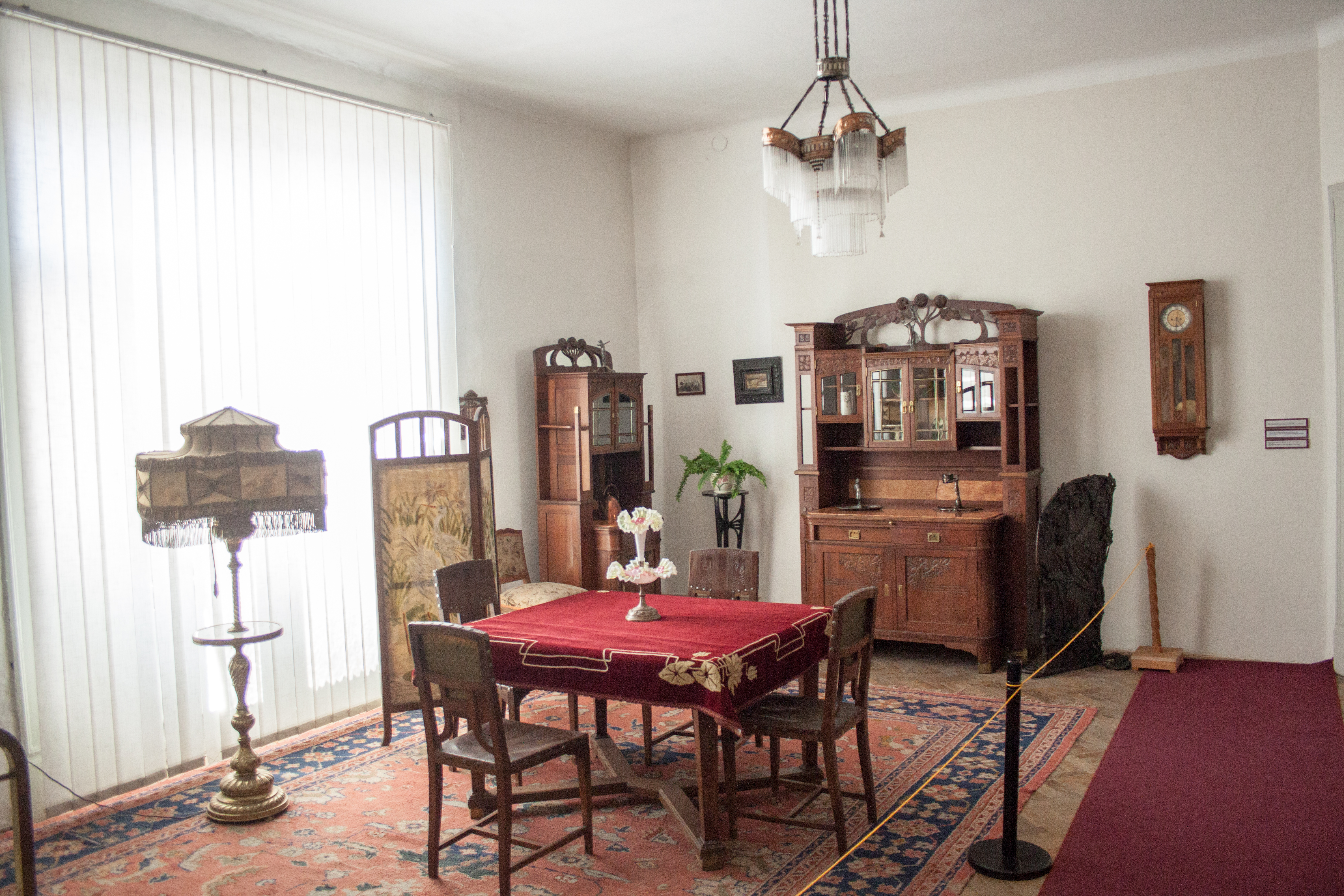
The urban strand of Polish Art Nouveau furniture is harder to identify with a single visual formula, because it drew on multiple European sources simultaneously: the Belgian and French Art Nouveau of Horta and Guimard, the Viennese Secession (Wiener Werkstätte), and the Munich Jugendstil. The degree of influence varied by city and by individual workshop.
In Kraków — the cultural capital of the movement, home of the Towarzystwo Przyjaciół Sztuk Pięknych gallery and the School of Fine Arts — furniture designs emerged from artists rather than from dedicated furniture manufacturers. Stanisław Wyspiański (1869–1907), known primarily for his stained glass and theatre, designed furniture and interiors characterised by flowing organic lines and an integration of structure and ornament. The furniture designed for the Medical Society building in Kraków (1904) is one of the most documented examples of his approach.
Key visual characteristics of urban Polish Art Nouveau furniture
- Organic curvilinear forms: legs with whiplash curves, stretchers with sinuous profiles, back rails with flowing plant-derived outlines
- Light woods preferred: birch, ash, maple — occasionally cherry — rather than the dark walnut of the Baroque period
- Inlaid decoration using contrasting fruitwoods or pewter and brass inlay, often depicting stylised irises, thistles, or abstract botanical forms
- In Secession-influenced pieces: more rectilinear geometry, flat surfaces punctuated by inlaid squares or rectangles, closer to the Wiener Werkstätte aesthetic
- Upholstery in muted greens, dusty roses, or ochre — fabrics with low-relief botanical patterns typical of the period
- Hardware: cast brass in organic forms, or minimal flat brass plates in the Secession manner
Distinguishing Period Pieces from Later Reproductions
Art Nouveau furniture has been reproduced steadily since the 1960s revival of interest in the style. Several indicators help separate pieces made before 1914 from later work:
Construction in a genuine pre-war piece is entirely hand-guided, even if machine tools were available. The joints — especially the point where legs meet seat rails on chairs — are mortise-and-tenon, hand-fitted, and slightly irregular. The backs of panels and the undersides of seats show hand-plane marks or early electric-belt-planer marks (slightly wavy striations rather than the perfectly smooth surface of later industrial planing). Screws in original hardware, where present, have off-centre slots and irregular thread spacing.
Veneer on genuine period pieces was cut with an early mechanical slicer (introduced in the 1870s in larger workshops) and runs between 0.6 and 1.5 mm thick. Later reproduction veneer is typically 0.3 mm or less. Original veneer also shows slight irregularity in thickness and sometimes fine saw marks at the edges where it was trimmed.
Museums and Collections
The Muzeum Narodowe w Krakowie holds the most significant collection of Young Poland-period decorative arts, including furniture associated with the Kraków workshops. The Muzeum Tatrzańskie in Zakopane (muzeumtatrzanskie.pl) has the primary collection of Zakopane-style objects in their original regional context. The Museum of Art in Łódź holds examples of Warsaw-produced Art Nouveau furniture from the same period.

